2026-05-28
Kind lies and unkind truths
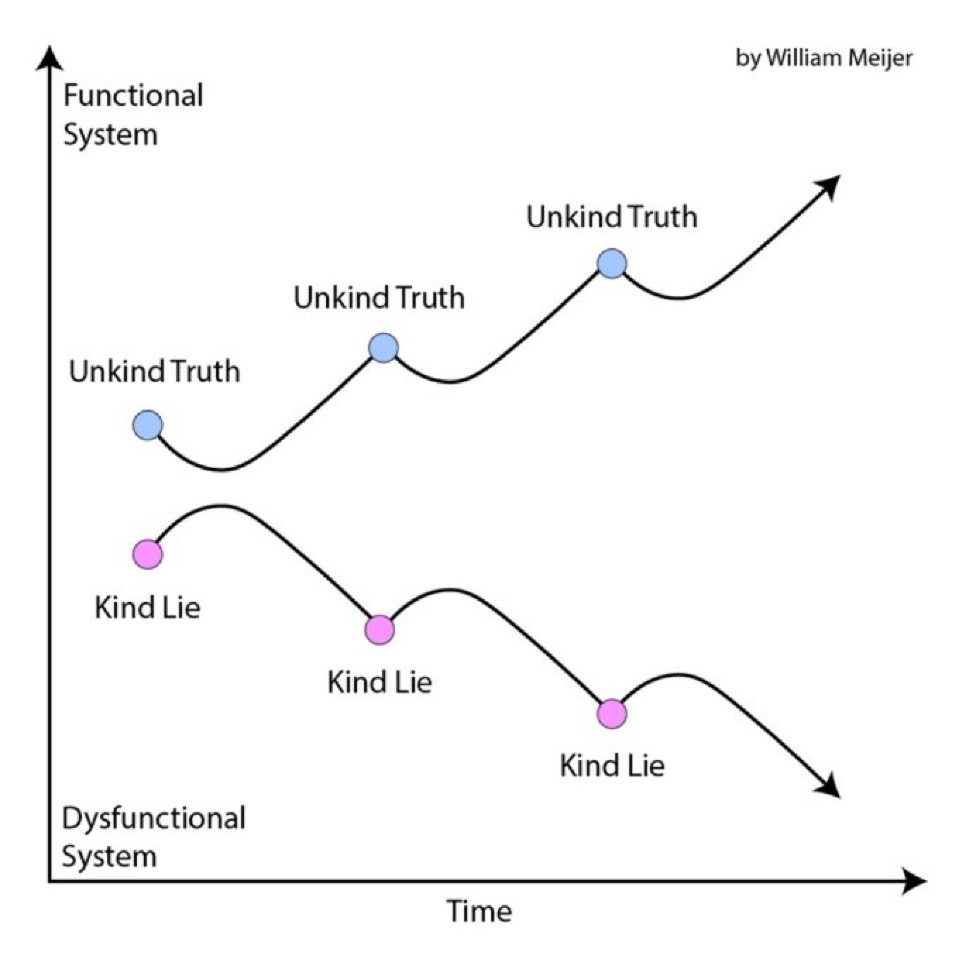
I believe that systems rarely become dysfunctional overnight. They usually begin to deteriorate in ways that, in the short term, seem perfectly reasonable.
That’s what’s interesting about the graph. The white lie improves the system at first. It reduces tension, avoids conflict, and maintains immediate stability. The line rises because the system stops confronting what could destabilize it.
And I believe that many modern societies function exactly this way.
Countries like Spain, France, or the United Kingdom have been accumulating structural problems for years that almost everyone partially recognizes: extreme difficulty in accessing housing, suffocating bureaucracy, overburdened public systems, loss of productivity, growing economic dependence, or younger generations increasingly disconnected from any real sense of progress.
But admitting the true magnitude of the problem would force us to accept something far more uncomfortable: that perhaps the current system can no longer sustain the expectations upon which it was built.
That’s when collective white lies start to emerge. Narratives designed to maintain social and emotional stability:
that everything is temporary, that “the economy is doing well,” that the next reform will solve the problem, that younger generations simply have expectations that are too high, or that normalizing precariousness is a reasonable adaptation.
And they work. For quite some time, in fact.
Because white lies don’t usually destroy systems immediately; they make them stable in the short term. The problem is that this stability begins to depend more and more on avoiding certain real conversations. And when that happens, the system loses its ability to correct itself.
I think something similar also happens on an individual level. The human brain is highly optimized to preserve local stability. If a narrative reduces immediate discomfort, we tend to reinforce it even if it is slowly degrading the overall system. That’s why it’s so easy to get used to dysfunctional states while we’re still functioning “well enough.”
And perhaps that’s the most unsettling part of the graph: the idea that a life, a relationship, or even a country can seem relatively stable for years while internally they depend more and more on truths that no one wants to look at directly.